 Whatcom County
 Why Barkley Homes Need Siding Built for This Climate
Barkley sits close enough to Bellingham Bay that homes here deal with a combination most inland siding never has to face: salty, moisture-laden air rolling in off the water, wind-driven rain that hits walls sideways instead of falling straight down, and a wet season that stretches long enough to keep exterior surfaces damp for weeks at a time. Any siding installed on a Barkley home has to hold up to all three at once, year after year, not just survive one bad winter.
Salt Air and Coastal Moisture
Salt-laden air accelerates corrosion on fasteners, staples, and any metal trim that isn't rated for coastal exposure, and it speeds up the breakdown of paint films and lower-grade composite sidings. Materials that aren't engineered for this exposure tend to show fading, chalking, or fastener staining years before they should.
Driving Rain and Wind-Driven Wet Walls
Whatcom County's storms frequently come with enough wind to drive rain up and under lap joints, around window trim, and behind poorly sealed corners. Siding that relies on face-sealed caulk joints instead of proper water management behind the cladding eventually lets moisture in, and once water gets behind siding in a climate this wet, it rarely dries out fast enough to prevent rot or mold in the wall assembly.
Moss, Mildew, and the Long Wet Season
Shaded lots, tree cover, and long stretches of overcast, damp weather give moss and mildew everything they need to take hold on north-facing walls and anywhere airflow is limited. Porous or absorbent siding materials hold onto that moisture, while a dense fiber cement surface with a factory finish sheds it far more effectively.
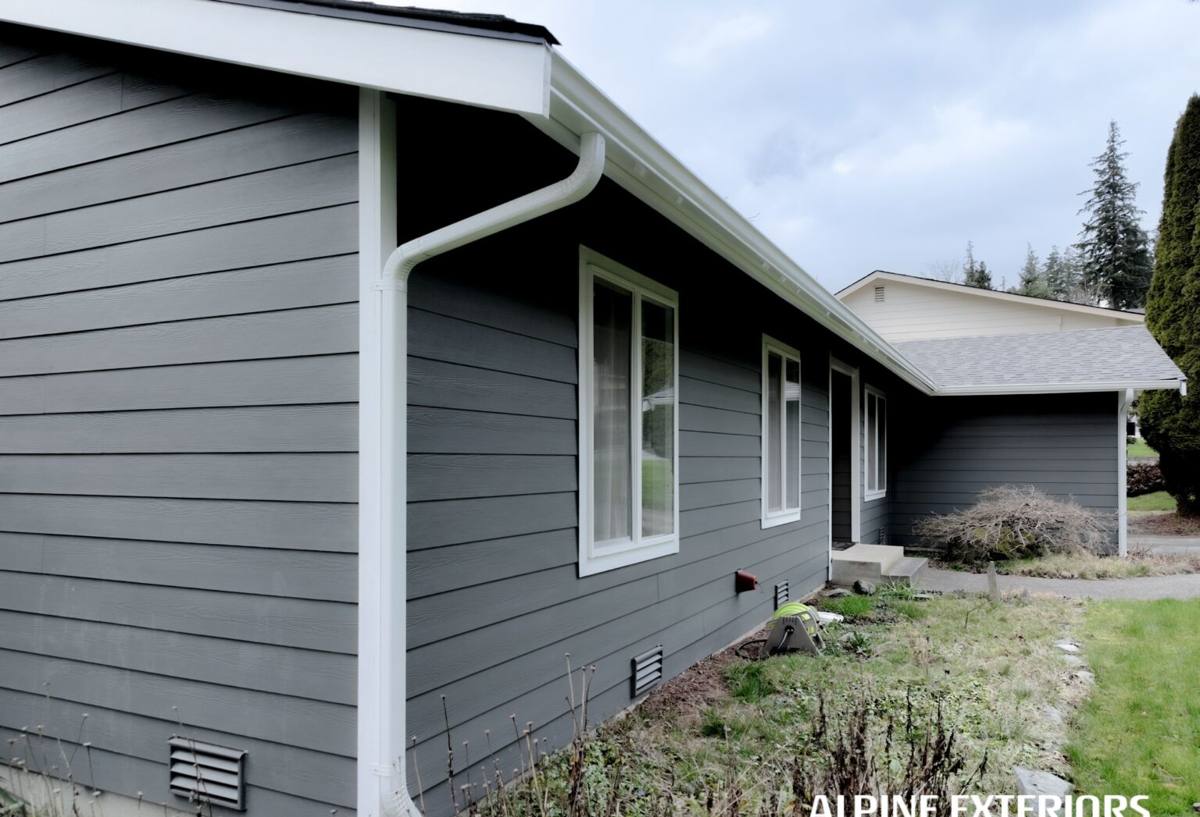
Why We Only Install James Hardie Fiber Cement
We made a deliberate decision as a company to install James Hardie fiber cement siding exclusively — not vinyl, not LP SmartSide, not Cemplank or Allura, not primed spruce or cedar. That's not a marketing gimmick; it's a standard we hold ourselves to because we've seen how each of those alternatives performs, or fails to perform, in exactly the kind of marine climate Barkley sits in.
James Hardie's fiber cement is non-combustible, which matters in a state where wildfire smoke and ember exposure have become a real concern even west of the Cascades. It's engineered specifically for different climate zones through Hardie's HZ product system, and the ColorPlus factory-applied finish is baked on under controlled conditions rather than field-painted, which gives it far more consistent, long-term color retention than site-applied paint on wood or composite products. When it's installed correctly, it's one of the few siding materials that genuinely holds up to salt air, driving rain, and a permanently damp shoulder season without an aggressive maintenance schedule.
The Right Hardie Products for a Barkley Home
Not every Hardie product is used the same way, and matching the right product to the home matters as much as the brand decision itself.
- HardiePlank lap siding — the most common choice for full-wall coverage, available in several exposure widths and profiles to match traditional or more contemporary Barkley home styles.
- HardieShingle siding — used for accent gables, dormers, or a full shingled look on homes that want more texture without moving to real wood shakes.
- HardiePanel vertical siding — often used for modern facades, porch ceilings, or as a contrast material against lap siding.
- HardieTrim boards — used around windows, doors, corners, and fascia so the entire exterior envelope, not just the field siding, is fiber cement rather than mixed with a lower-grade trim product.
For this region, Hardie's engineered-for-climate approach means specifying products built for wetter, cooler zones rather than a generic all-climate spec — this affects the moisture-resistant backer, the recommended fastening pattern, and the finish warranty terms.
What a Correct Installation Involves
Fiber cement siding is only as good as the installation behind it. Most of the failures we get called out to inspect on other companies' work trace back to installation shortcuts, not the material itself.
Water Management Behind the Siding
Correct installation starts with a drainage plane — typically a weather-resistive barrier with a rain screen gap or drainable house wrap — so that any moisture that does get past the siding face has somewhere to go and can dry out. This is especially important on Barkley walls that take direct wind-driven rain, where face-sealing alone is never enough on its own.
Fastening and Manufacturer Specs
James Hardie publishes specific fastener types, spacing, and penetration requirements for coastal and high-wind zones. Using the wrong fastener, or hand-nailing at the wrong spacing, can void the manufacturer's warranty and lead to boards that crack, cup, or pull loose over time. We install to Hardie's published specifications, not shortcuts that speed up the job.
Clearances, Flashing, and Trim Details
Siding needs proper clearance from grade, decks, roofs, and other transitions to avoid wicking moisture from below. Flashing at windows, doors, and butt joints has to be integrated correctly with the water-resistive barrier — not just caulked over — and joints should be back-primed and fastened per spec so the factory ColorPlus finish isn't the only thing standing between the wall and the weather.
How James Hardie Compares to the Alternatives
Homeowners often ask why we don't offer a cheaper alternative alongside Hardie. Here's an honest, side-by-side look at how the main options perform in a climate like Whatcom County's.
| Factor | James Hardie Fiber Cement | Vinyl Siding | Wood / LP SmartSide |
|---|---|---|---|
| Moisture resistance | High when installed with proper drainage plane | Sheds water but joints can flex and gap over time | Vulnerable to swelling and rot if the engineered coating is compromised |
| Fire performance | Non-combustible | Melts and contributes fuel in direct flame exposure | Combustible |
| Color retention | Factory ColorPlus finish, long-term consistency | Can fade and become brittle with UV exposure | Field-applied paint needs more frequent repainting |
| Maintenance burden | Occasional wash, minimal repainting | Low but prone to warping/cracking with age | Regular repainting and moisture monitoring |
| Typical lifespan expectation | Multiple decades when installed to spec | Shorter functional life in harsh coastal exposure | Shorter than fiber cement, especially in wet climates |
None of these alternatives are junk products across the board — vinyl is inexpensive and low-maintenance in mild climates, and engineered wood products have real strengths in drier regions. But given what Barkley's salt air, wind-driven rain, and moss season put an exterior through, we standardized on the one material that consistently holds up to all three without special-case exceptions.
Our Process for Barkley Siding Projects
Every project starts with an on-site inspection of the existing exterior, not just a measurement for materials. We're checking the condition of the sheathing underneath, looking for existing moisture damage around windows and penetrations, and identifying any areas where the current drainage plane has already failed. That inspection shapes the actual scope of work before we ever quote a number.
- On-site assessment of existing siding, trim, and any visible moisture or rot issues
- Written estimate covering removal, any necessary sheathing repair, house wrap/rain screen, Hardie materials, and trim
- Tear-off and inspection of the wall assembly once old siding is removed
- Installation of the water-resistive barrier and drainage plane, then Hardie siding, trim, and flashing to manufacturer spec
- Final walk-through and cleanup
Living with Hardie Siding in a Marine Climate
Correctly installed Hardie siding is genuinely low-maintenance, but "low-maintenance" isn't "no-maintenance" in a climate this wet. A short annual routine keeps it performing the way it's designed to:
- Rinse siding once or twice a year to clear salt residue, pollen, and airborne grime before it builds up
- Check north-facing and shaded walls for early moss or mildew growth and address it before it spreads
- Inspect caulking at trim joints, windows, and doors annually and re-caulk any cracked or shrunk sections
- Keep gutters clear and downspouts directed away from the wall so water isn't sheeting down the siding face
- Trim back vegetation and tree cover that keeps a wall section shaded and damp for extended periods
Why Hiring a Crew That Already Works in Barkley Matters
Siding installation isn't one-size-fits-all across Whatcom County. A crew that regularly works in and around Bellingham neighborhoods like Barkley already understands how orientation to the bay, tree cover, and prevailing storm direction affect where a given home is most vulnerable, and they've seen firsthand how different products and installation shortcuts hold up — or don't — after a few wet winters. That local track record shows up in fewer callbacks, fewer surprises during tear-off, and an installation crew that isn't learning the region's quirks on your project.
If you're planning a siding replacement or want a second opinion on an existing installation, we're happy to take a look and walk you through what we'd recommend for your specific home. Reach out for a free, no-pressure estimate using the form below.