 Whatcom County
 Why Lynden Homes Need Siding Built for This Climate
Lynden sits inland from Bellingham Bay, but it still lives inside the same weather system that soaks all of Whatcom County. The marine air off the Salish Sea pushes damp, salt-tinged moisture up the valley, and it settles into siding, trim, and anything with a north-facing wall that doesn't see much sun. Add the driving rain that comes sideways off winter storms, and a moss season that can run from October through May, and you have an exterior envelope that's under near-constant pressure for most of the year.
Most siding failures we see on Lynden homes aren't dramatic. They're slow: a swollen bottom edge on a lap board, a soft spot behind a downspout, moss creeping into a seam and holding water against the wall for weeks at a time. None of that happens overnight, and none of it is caused by one bad storm. It's the cumulative effect of a wet climate working on a product or installation that wasn't built to handle it.
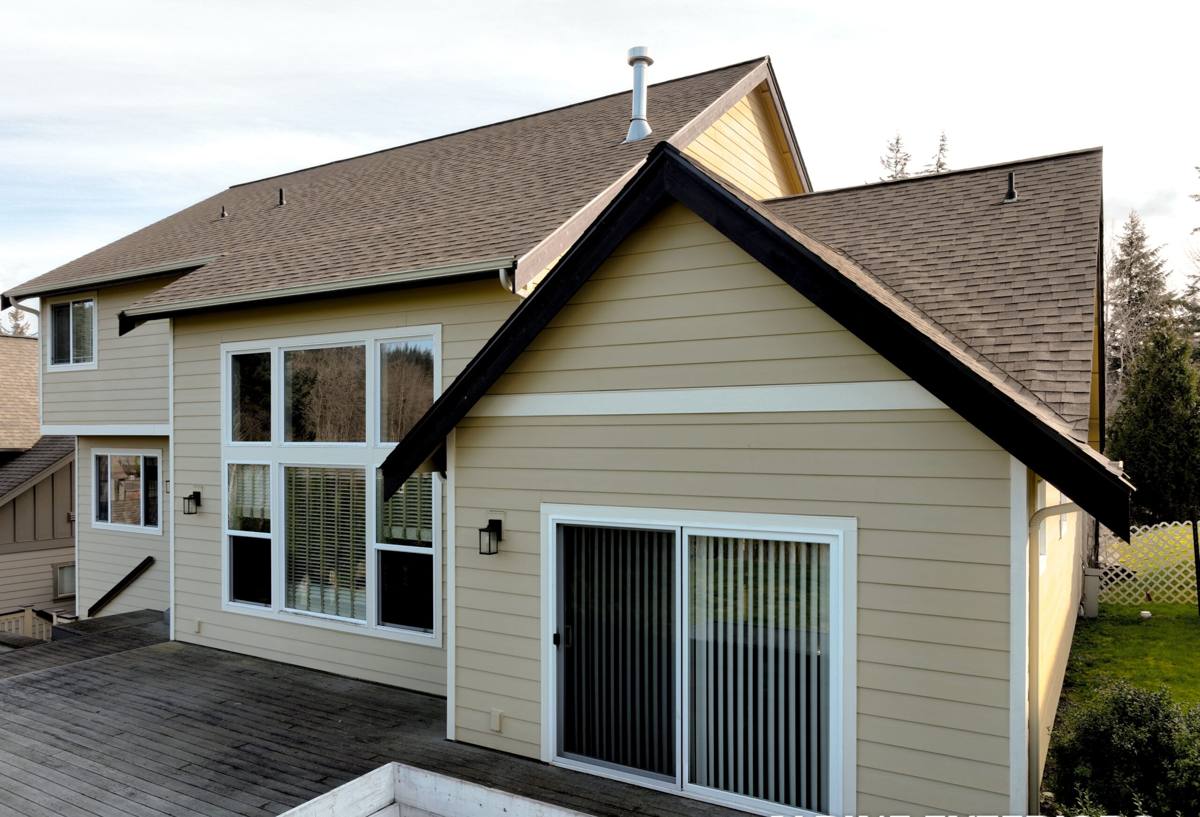
What Whatcom County's Weather Actually Does to Siding
Moisture That Doesn't Dry Out
In a drier climate, siding gets wet and then gets a chance to dry before the next rain. In Lynden, that drying window is often short or nonexistent for months at a stretch. Wood-based siding products absorb that moisture at the edges and behind poorly lapped joints, and if it can't evaporate before the next rain, it stays trapped. Over years, that's what causes swelling, delamination, and rot at butt joints and bottom courses.
Moss and Organic Growth
Moss doesn't just sit on top of siding — it holds moisture against the surface and works into any gap it can find, prying seams open a little more each season. On shaded walls, under eaves, and along fence lines and tree cover common around Lynden properties, moss can colonize a wall faster than most homeowners expect.
Wind-Driven Rain
Storms off the strait don't just fall straight down — they drive rain horizontally into wall assemblies, testing every seam, joint, and penetration. A siding job that looks fine on a calm day can leak the first time a real system rolls through, if the flashing and laps weren't detailed correctly.
Why We Install Only James Hardie Fiber Cement
We get asked regularly why we don't offer vinyl, LP SmartSide, or other engineered wood products. The honest answer is that we've made a professional call: in a climate like Whatcom County's, those products ask homeowners to accept trade-offs we're not willing to install and stand behind.
Vinyl siding is affordable and low-maintenance in a general sense, but it expands and contracts significantly with temperature swings, and its seams and J-channels give moisture a path inward that's hard to fully seal against driving rain. LP SmartSide and other engineered wood products perform well when detailing and caulking are kept up over the years, but they're wood-based at the core — meaning sustained moisture exposure, if maintenance ever lapses, has a real path to cause damage.
James Hardie fiber cement is engineered specifically for this kind of climate. It's non-combustible, it doesn't swell or rot the way wood-based products can, and its ColorPlus factory finish is baked on rather than field-applied, which means the color layer resists the fading and chalking that Northwest sun and rain cycles can cause on site-painted products. Hardie's HZ5 product line is formulated for exactly the wet, moss-prone, freeze-thaw conditions Whatcom County sees. It's also backed by a strong transferable warranty on the substrate, which matters more here than in drier climates because the material is doing real work every day it's on the wall.
What Correct Siding Installation Actually Involves
Fiber cement siding is only as good as the installation behind it. Hardie's own installation manual is specific for a reason — in a climate like this one, small shortcuts show up as real problems within a few years.
- Weather-resistive barrier and flashing first. The siding is the last layer, not the waterproofing. Housewrap, window and door flashing, and kick-out flashing at roof-to-wall intersections all have to be correct before a single board goes up.
- Proper clearances. Hardie specifies minimum gaps between siding and roofing, decks, and grade. Skipping these is one of the most common causes of moisture damage we find when we're called in to fix someone else's work.
- Correct fastening. Nail placement, spacing, and depth all affect how the boards perform over time. Overdriven or underdriven fasteners are a quiet, common failure point.
- Butt joints sealed and staggered. Every horizontal joint is a place water wants to get in. They need to be caulked with the right product and staggered so no seam pattern lines up vertically down the wall.
- Field-cut edges sealed. Any board cut on site exposes raw fiber cement that needs to be primed and painted to match — this is one of the most commonly skipped steps on rushed jobs.
Our Process, Start to Finish
Assessment and Estimate
We walk the exterior, look at the current siding's condition, check for moisture damage at trim, windows, and grade level, and talk through what's driving the replacement — failing siding, a remodel, or just wanting something that will hold up better in Whatcom County's weather.
Prep and Weather Barrier
Old siding comes off, sheathing is inspected and repaired where needed, and a new weather-resistive barrier goes on with correctly integrated window, door, and penetration flashing before any Hardie product touches the wall.
Installation to Spec
Boards, panels, or trim go up following Hardie's fastening schedule and clearance requirements, with joints staggered and sealed as we go rather than caught up at the end.
Finish and Walkthrough
Caulking, touch-up paint on any field cuts, and a final walkthrough so you can see the work up close before we consider the job done.
James Hardie Product Lines for Lynden Homes
| Product | Best For | Look |
|---|---|---|
| HardiePlank lap siding | Most Lynden homes, traditional and modern styles | Classic horizontal lap, multiple textures |
| HardiePanel vertical siding | Accent walls, gables, modern/farmhouse styles | Clean vertical lines |
| HardieShingle siding | Craftsman or cottage-style homes | Staggered or straight shingle profile |
| HardieTrim boards | Corners, window and door surrounds | Crisp, paint-ready trim lines |
All of it comes in ColorPlus factory-finished colors, so the color coat is cured and consistent before it ever reaches the wall — a real advantage in a climate where field-painted finishes take a beating from repeated wet-dry cycles.
Cost Factors for a Lynden Siding Project
| Factor | Why It Matters |
|---|---|
| Home size and wall complexity | More corners, gables, and dormers mean more cuts, trim, and labor |
| Condition of existing sheathing | Hidden rot or moisture damage found during tear-off adds repair work |
| Product line and profile | Plank, panel, and shingle styles carry different material and labor costs |
| Trim and detail work | Custom trim around windows, doors, and corners adds time |
| Access and site conditions | Tree cover, tight lot lines, or multi-story walls affect labor time |
We give a firm, itemized estimate after seeing the home in person — we don't quote off photos or square footage alone, because the details that drive cost are the same details that determine whether the job holds up in this climate.
Signs a Lynden Home May Need New Siding
- Soft or spongy spots when you press on the siding, especially near the bottom courses
- Paint that's peeling, bubbling, or failing repeatedly in the same spots
- Moss or dark staining that keeps coming back after cleaning
- Visible gaps, warping, or boards pulling away from the wall
- Rising energy bills that suggest the wall assembly isn't performing the way it should
- Siding that's simply reached the end of its expected service life
Why Hire a Crew That Already Works Whatcom County
Siding installation isn't generic work. A crew that installs in dry inland climates can do a technically fine job and still miss the details that matter most here — flashing at roof-to-wall transitions, clearance at grade, joint sealing that accounts for months of sustained dampness. Working Whatcom County regularly, including towns like Lynden, means we're not guessing at how this weather behaves — we're building to it every week, and we stand behind the work with that in mind.
If your Lynden home's siding is showing its age, or you're planning ahead for a replacement, we're happy to take a look and give you a straightforward, no-pressure estimate — just fill out the form below.