 Whatcom County
 Building Decks for Barkley Homes: Same Job, Different Climate
A deck in Barkley has to earn its keep in a way decks in drier parts of the country don't. Whatcom County sits close enough to the water that salt air is a real factor on fasteners and finishes, the rainy season runs long and heavy, and moss doesn't wait for an invitation — it shows up on any horizontal wood surface that stays damp for more than a few days. A deck that's framed, fastened, and finished the way it would be in a dry inland climate will show problems here faster than most homeowners expect: soft spots at the ledger, green film on the boards by the second winter, corroding hardware, and fasteners that back out or stain the wood around them.
None of that is unusual or a sign of bad luck. It's just what this climate does to a structure that sits outside, low to the ground, catching runoff and shade at the same time. Building it correctly the first time — with the right materials, the right flashing, and the right slope — is what keeps a deck solid and good-looking for decades instead of needing rework in year five.
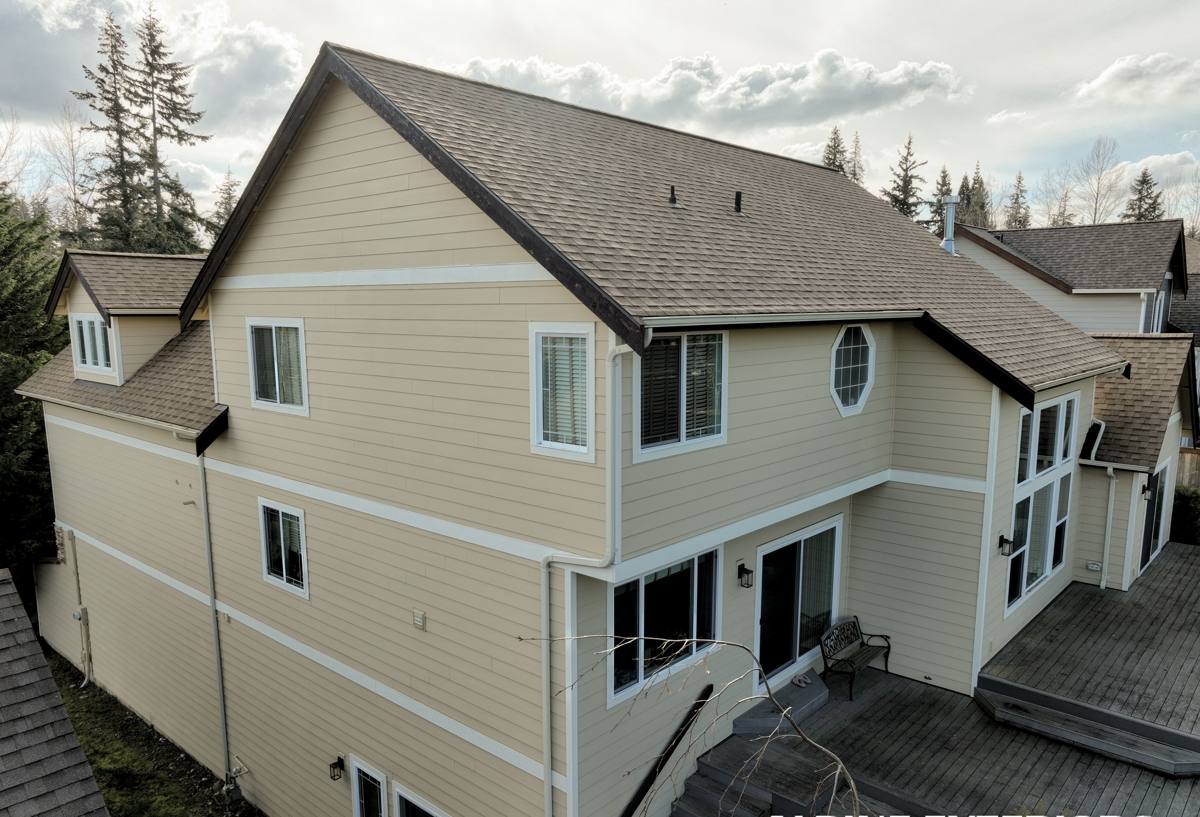
What Whatcom County's Wet Season Actually Does to a Deck
Moisture Is the Real Enemy, Not Cold
Barkley doesn't see brutal winters, but it sees a lot of moisture over a lot of months. That's a different — and in some ways harder — problem than freeze-thaw damage. Wood that stays wet for extended stretches invites rot at joints, fastener holes, and anywhere two boards sit tight against each other without room to dry. The areas that fail first on a poorly built deck are almost always the same: the ledger board where the deck meets the house, joist tops under the decking, and stair stringers where water pools at the base.
Moss and Mildew on Deck Surfaces
Long gray stretches with limited direct sun mean any deck surface that doesn't drain and dry quickly will grow moss or mildew, especially on the north or shaded side of a house, or under tree cover — common in the more wooded pockets around Barkley. Moss on a deck isn't just cosmetic. It holds moisture against the board surface and makes the deck genuinely slick and dangerous underfoot, which matters more on stairs and landings than open deck fields.
Salt Air and Metal Hardware
Whatcom County's proximity to Bellingham Bay and the Salish Sea means airborne salt is part of the environment, even inland of the immediate waterfront. Standard, uncoated fasteners and connectors corrode faster here than in a landlocked climate. Corroding hardware doesn't just look bad with rust streaks down the siding or decking — it loses holding strength over time, which is a structural issue on a deck people stand and gather on.
What a Correctly Built Deck Requires Here
A deck built for this climate isn't a different design — it's the same good framing practices done with more attention to water management. The fundamentals that matter most in Barkley's conditions:
- Proper ledger flashing where the deck attaches to the house, so water is directed away from the rim joist and wall sheathing rather than trapped behind the ledger board
- Joist tape or an equivalent protective membrane on top of every joist, so the decking fasteners don't create a moisture trap at every screw hole
- Consistent slope away from the house — usually a small fraction of an inch per foot — so water sheets off the deck surface instead of pooling
- Gaps between deck boards sized correctly for the material, allowing airflow and drainage instead of trapping debris and moisture
- Corrosion-resistant fasteners and structural hardware rated for the exposure, not just whatever is cheapest at the yard
- Footings set to the frost and bearing depth required by code, on soil that's been checked rather than assumed
Skip any one of these and the deck may look fine for a season or two before the climate starts finding the weak point.
Choosing Decking Material for a Barkley Home
There's no single "right" material for every home — it depends on budget, how much upkeep you want to do, and how the deck will be used. Here's how the common options stack up specifically against Whatcom County's wet, mossy conditions:
| Material | Upfront Cost | Moisture & Moss Behavior Here | Maintenance |
|---|---|---|---|
| Pressure-treated wood | Lowest | Rot-resistant treatment helps, but surface still holds moisture and grows moss/mildew without regular cleaning and sealing | Annual cleaning; re-sealing every 1–3 years |
| Cedar | Moderate | Naturally moisture- and insect-resistant, but the surface still needs care to prevent graying and moss in shaded areas | Periodic cleaning and oiling to maintain appearance |
| Capped composite | Higher | Cap layer sheds water and resists moss far better than uncapped wood; performs well through the wet season | Occasional washing; no sealing or staining |
| PVC decking | Highest | Fully synthetic, essentially impervious to moisture and rot; best moss resistance of the group | Lowest — periodic washing only |
For a home with a lot of shade or tree cover — not uncommon around Barkley's greenbelt and pond areas — a capped composite or PVC product earns its higher upfront cost back in reduced moss battles and fewer weekends spent cleaning and resealing. For a sunnier, more open lot, a well-maintained wood deck can perform just fine as long as the owner is realistic about the annual upkeep it needs.
Flashing, Fasteners, and Hardware That Hold Up in This Climate
This is where a lot of decks quietly fail years down the road, and it's largely invisible once the deck is finished — which is exactly why it has to be done right the first time. We use fasteners and structural connectors rated for exterior, coastal-adjacent exposure rather than standard interior-grade or economy hardware. Ledger flashing is installed as a system — flashing, a water-resistant barrier, and correct step flashing where the deck meets siding — not just a single strip of metal. Post bases and joist hangers are chosen for corrosion resistance, since these are the connections holding the most load and the hardest to inspect once the deck is built and the boards are down.
Permits and Code Requirements
Deck construction is governed by the residential building code, and most decks above a certain height or size require a permit, an inspection, or both — whether that runs through the City of Bellingham or Whatcom County depending on the exact property location. Requirements typically cover things like guardrail height, baluster spacing, stair rise and run, and how the ledger attaches to the house structure. We handle the permitting and inspection process as part of the job, so homeowners aren't left figuring out code requirements on their own or discovering after the fact that a deck was built out of compliance.
Our Deck Building Process
The steps are straightforward, but the details inside each one are where quality shows up:
- On-site assessment — we look at the house's ledger location, grade, drainage, sun/shade exposure, and how the deck will actually be used
- Design and material selection — sizing, layout, and a material recommendation based on your budget and how much upkeep you want long-term
- Permitting — drawings and applications submitted to the appropriate jurisdiction, inspections scheduled around the build
- Footings and framing — footings set to proper depth, ledger flashed correctly, joists set with drainage and slope in mind
- Decking, railing, and stairs installed — with fastening methods and gaps appropriate to the chosen material
- Final walkthrough — we go over care and maintenance expectations specific to the material you chose, so there are no surprises the first wet winter
Maintaining a New Deck Through Whatcom County Winters
Even a well-built deck benefits from a little seasonal attention, and what it needs depends on the material:
- Clear leaves and debris out of gaps between boards before the wet season sets in, so they don't trap moisture against the surface
- Sweep or rinse off moss growth promptly rather than letting it establish — it's much easier to remove early
- Check that gutters and downspouts near the deck are directing water away rather than dumping onto or near the structure
- For wood decks, plan on cleaning and resealing on the schedule appropriate to the product — skipping a cycle is when moisture problems start
- Do a quick check of railings and stair connections once a year — hardware is the first place to show wear in this climate
Why Hire a Crew That Already Works in Barkley
A contractor who builds decks across a range of climates knows general best practice. A contractor who works Whatcom County regularly knows which details actually matter here — which fastener grades hold up near the water, how much slope is really needed given how much rain this area gets, and which shaded lots are going to fight moss no matter what material goes down. That local pattern recognition is what separates a deck that looks good at handoff from one that still looks good in year ten. We build decks throughout Whatcom County, including in and around Barkley, and we bring that same standard — correct flashing, correct fasteners, correct slope — to every job regardless of size or budget.
If you're planning a new deck or replacing one that's showing its age, we're happy to take a look and put together a straightforward, no-pressure estimate. There's a form below — fill it out and we'll get back to you.